Why Your Naples Sunroom Becomes Unbearable by Memorial Day
You invested in that beautiful Florida room to enjoy Naples’ legendary sunshine—then discovered it transforms into a greenhouse the moment temperatures climb past 85°F. Glass-enclosed spaces in Southwest Florida can reach internal temperatures exceeding 120°F when outdoor conditions hit the summer average of 91°F (Source: National Weather Service Tampa Bay, 2023). Your air conditioning struggles, your Florida Power & Light bill skyrockets, and that gorgeous sunroom sits empty from May through October.
This isn’t a design flaw unique to your home. Whether you live in a sprawling estate near Naples Botanical Garden, a ranch home in Vineyards, or a glass-enclosed balcony condo overlooking Pelican Bay, the physics work against you. Naples receives approximately 2,900 hours of sunshine annually (Source: U.S. Climate Data, 2024), and all that solar radiation passes through your windows, heats interior surfaces, and gets trapped. Standard curtains and decorative blinds weren’t designed for this intensity—they manage light, not thermal load.
The Real Cost of an Unusable Florida Room
Homeowners in Lely Resort and Fiddlers Creek tell us the same story: they use their sunrooms maybe four months a year. That’s a significant portion of your home’s square footage sitting dormant. Meanwhile, unshaded sunrooms can increase whole-home cooling costs by 25-30% (Source: U.S. Department of Energy, 2022) because your HVAC system fights a losing battle against solar heat gain. In a region where average summer electricity bills already exceed $200 monthly (Source: Florida Power & Light Rate Analysis, 2024), that inefficiency adds up fast.
Engineered Shading vs. Decorative Window Treatments
The distinction matters for Naples homeowners. Decorative window treatments—standard blinds, draperies, plantation shutters—prioritize aesthetics and light control. They diffuse glare and provide privacy, but they do little to reject heat before it enters your space. Engineered shading solutions are designed specifically for thermal performance, using materials and configurations that block or reflect solar radiation while maintaining your view of the palms and preserves outside.
How Engineered Shading Works in Extreme Conditions
True engineered shading systems use technical fabrics with quantified Solar Heat Gain Coefficients (SHGC). A lower SHGC means less heat passes through. High-performance solar shades can achieve SHGC ratings of 0.10-0.25, blocking 75-90% of solar heat gain (Source: ENERGY STAR Window Attachment Guidelines, 2023). Compare that to standard fabric blinds at 0.40-0.60 SHGC, and you understand why your current treatments feel inadequate during a Naples July.
The best systems for Naples sunrooms combine:
- Reflective exterior-facing surfaces that bounce radiation before it penetrates glass
- Low-emissivity coatings that reduce infrared heat transfer
- Tight edge gaps and side channels that eliminate convective heat bypass
- UV-stabilized materials rated for 2,500+ hours of direct sun exposure annually
For homeowners near the Conservancy of Southwest Florida and throughout Naples Lakes Country Club, this technology means your Florida room stays comfortable when ambient conditions would otherwise make it unusable.
Matching Shading Solutions to Naples Architectural Styles
Naples’ housing stock presents distinct challenges. A one-size-fits-all approach fails because a 1970s ranch home with an enclosed lanai has different framing, glass types, and spatial proportions than a modern high-rise conservatory or a Mediterranean estate’s solarium.
Ranch Homes with Enclosed Lanais
Your typical Vineyards or Golden Gate Estates ranch features a lanai converted to conditioned space with single-pane or basic double-pane glass. These structures often have aluminum frames with minimal insulation value. Exterior solar screens or interior cellular shades with side tracks perform best here, addressing both radiant and convective heat paths. Motorization proves particularly valuable for hard-to-reach applications above pool cage conversions.
Estate Homes with Conservatories
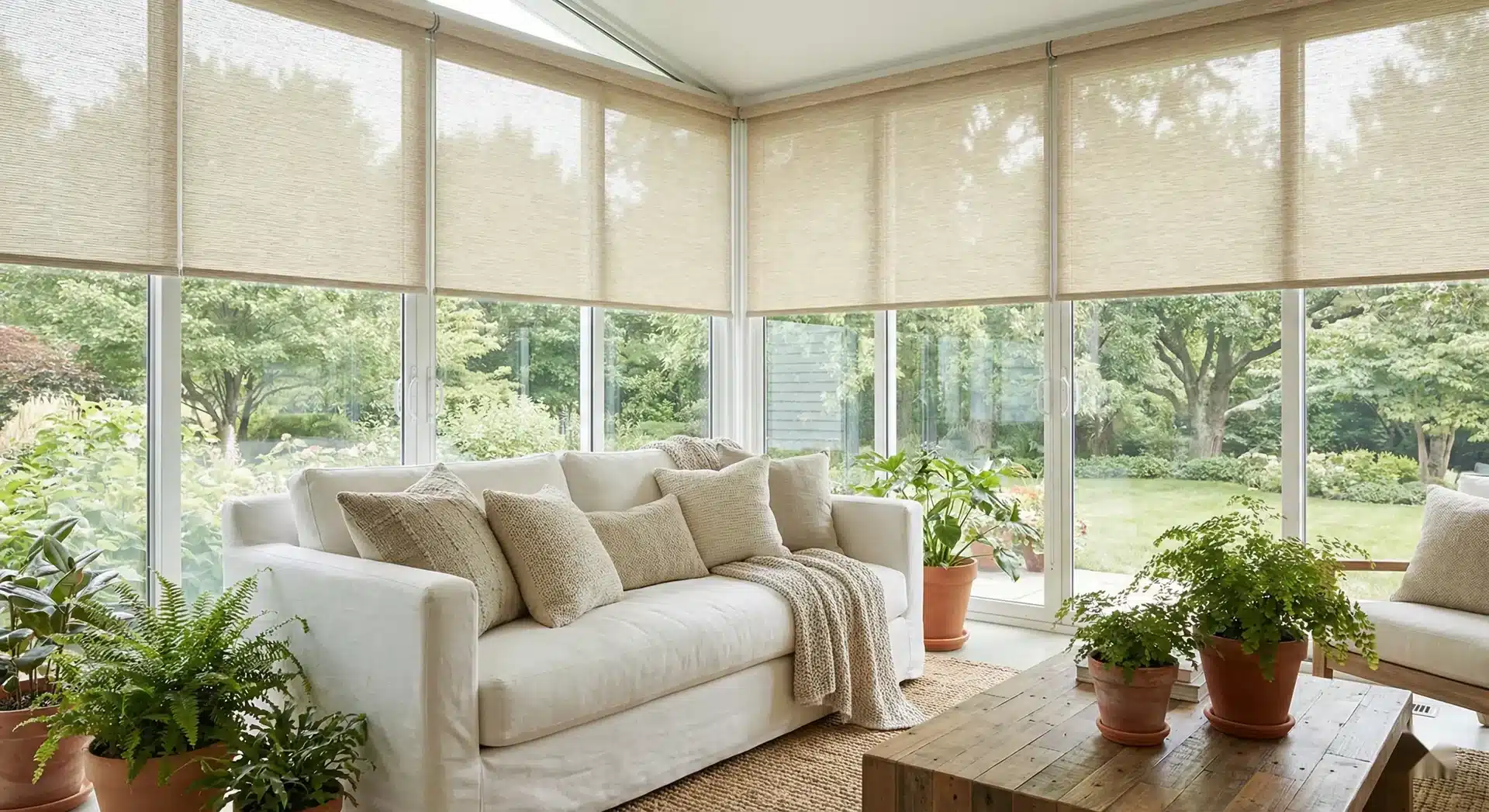
Larger properties in Fiddlers Creek and Port Royal often feature formal conservatories with expansive glass ceilings. Overhead glazing creates the most intense heat gain—horizontal glass surfaces receive up to 300% more solar radiation than vertical windows during summer months (Source: ASHRAE Fundamentals Handbook, 2021). These spaces require specialized overhead shading systems, often motorized tensioned shades that can span significant distances without sagging.
Condos with Glass-Enclosed Balconies
High-rise residents along Gulf Shore Boulevard and in Pelican Bay face unique constraints: HOA aesthetic requirements, structural limitations on exterior modifications, and often floor-to-ceiling glass that amplifies both views and heat. Dual-roller shade systems offer flexibility—a solar shade for daytime heat rejection, a blackout shade for privacy—all within a compact headrail that meets most association guidelines.
| Naples Home Type | Primary Challenge | Recommended Engineered Solution | Expected Heat Rejection |
|---|---|---|---|
| Ranch with enclosed lanai | Basic glass, aluminum frames | Cellular shades with side tracks | 60-70% |
| Estate conservatory | Overhead glazing, large spans | Motorized tensioned solar shades | 75-85% |
| Condo glass balcony | HOA restrictions, floor-to-ceiling glass | Dual-roller shade systems | 70-80% |
The Financial Case for Engineered Sunroom Shading in Naples
Beyond comfort, the numbers justify investment. Properly specified solar shading can reduce sunroom-related cooling loads by 40-60% (Source: Lawrence Berkeley National Laboratory Windows Research, 2022). For a Naples homeowner currently running dedicated mini-splits or zone cooling for an unusable space, annual savings of $400-800 are realistic depending on square footage and usage patterns.
“My Florida Power & Light bill dropped $127 the first full month after installation. The sunroom went from a storage area to where we have breakfast every morning.”
— Margaret L., Vineyards, installed motorized solar shades in 480 sq. ft. conservatory
More importantly, you reclaim functional living space. Real estate appraisers in Collier County increasingly distinguish between finished sunrooms with climate control solutions and those without. Functional Florida rooms contribute 50-75% of their square footage value to appraisals, while unusable glass enclosures may contribute as little as 25% (Source: National Association of Home Builders Remodeling Impact Report, 2023).
Why Naples Homeowners Trust Local Expertise
Generic shading recommendations from national catalogs don’t account for Naples’ specific conditions: the angle of summer sun at latitude 26°N, the high humidity that affects material longevity, the salt air corrosion potential for coastal properties, or the hurricane considerations that matter for any window treatment in Southwest Florida. Professionals who’ve worked in Lely Resort understand that a solution performing well in Phoenix or San Diego may fail here within two seasons.
We’ve installed engineered shading in over 300 Naples sunrooms across every neighborhood from Pine Ridge to Naples Lakes Country Club. Our assessments consider your specific orientation, glass type, framing materials, and how you actually want to use the space—not just generic solar calculations.
Getting Started: Your Free Sunroom Shading Assessment
Every Naples sunroom presents unique variables. Orientation determines peak heat gain timing. Glass specifications affect baseline performance. Existing HVAC capacity influences how much thermal reduction you need to achieve comfort. A proper assessment measures actual conditions in your space rather than estimating from averages.
During your complimentary consultation, we’ll:
- Measure your sunroom’s dimensions and document glass specifications
- Assess current thermal conditions with infrared imaging when possible
- Discuss your aesthetic preferences and any HOA requirements
- Recommend specific engineered solutions with projected performance
- Provide transparent pricing with no obligation
Get your free sunroom shading assessment and enjoy your Florida room year-round. Whether you’re in a Fiddlers Creek estate or a downtown Naples condo, you deserve to use every square foot you’re paying to cool. Contact us today to schedule your evaluation.
Frequently Asked Questions About Sunroom Shades in Naples
Can motorized shades integrate with my existing smart home system?
Most engineered shading systems now offer integration with popular platforms including Lutron, Control4, and standard WiFi protocols. Many Naples homeowners program their sunroom shades to lower automatically when interior temperature sensors detect specific thresholds, maximizing both comfort and energy efficiency without manual intervention.
How do engineered shading materials hold up to Naples humidity and salt air?
Quality solar shade fabrics are inherently moisture-resistant, constructed from PVC-coated fiberglass or polyester that won’t absorb humidity or support mold growth. For coastal Naples properties, we specify marine-grade hardware and corrosion-resistant components rated for saltwater environments—critical for homes within five miles of the Gulf.
Will solar shades block my view of the landscaping and water features?
Engineered solar fabrics are available in openness factors ranging from 1% to 14%. A 5% openness fabric rejects substantial heat while maintaining clear outward visibility during daylight hours. You’ll still enjoy your views of the Naples Botanical Garden-inspired landscaping—the shades simply reduce glare and heat without creating the cave effect of traditional blackout treatments.
Frequently Asked Questions
Can motorized shades integrate with my existing smart home system?
Most engineered shading systems now offer integration with popular platforms including Lutron, Control4, and standard WiFi protocols. Many Naples homeowners program their sunroom shades to lower automatically when interior temperature sensors detect specific thresholds, maximizing both comfort and energy efficiency without manual intervention.
How do engineered shading materials hold up to Naples humidity and salt air?
Quality solar shade fabrics are inherently moisture-resistant, constructed from PVC-coated fiberglass or polyester that won’t absorb humidity or support mold growth. For coastal Naples properties, we specify marine-grade hardware and corrosion-resistant components rated for saltwater environments—critical for homes within five miles of the Gulf.
Will solar shades block my view of the landscaping and water features?
Engineered solar fabrics are available in openness factors ranging from 1% to 14%. A 5% openness fabric rejects substantial heat while maintaining clear outward visibility during daylight hours. You’ll still enjoy your views of the Naples Botanical Garden-inspired landscaping—the shades simply reduce glare and heat without creating the cave effect of traditional blackout treatments.